Launching SMD: Space Engineering in the Browser
SMD Team ·
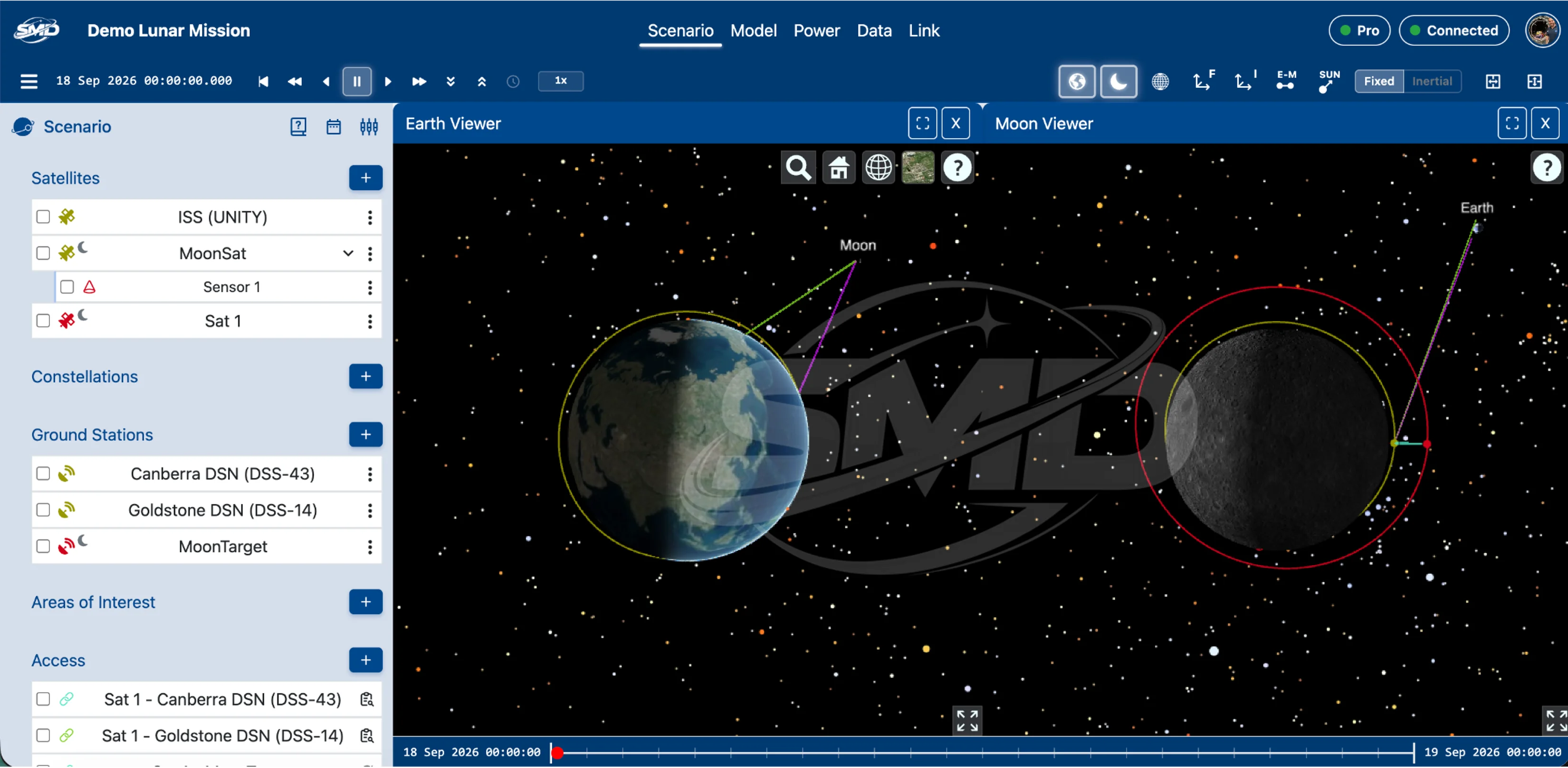
SMD’s scenario workspace: interactive 3D orbit visualization (Earth/Moon), multi-satellite scenarios, access analysis, and subsystem analysis.
Today, we are launching Space Mission Designer (SMD).
SMD is a browser-based environment for model-based space mission engineering, bringing orbital dynamics, spacecraft modeling, mission analysis, subsystem budgets, ground-station access, and constellation analysis into a single mission environment.
The idea behind SMD is simple:
A space mission should be designed and analyzed as a system, not as a collection of disconnected tools.
Why We Built SMD
A space mission is inherently a systems engineering problem.
The orbit determines the environment in which the spacecraft operates. The spacecraft configuration affects power generation, attitude constraints, and payload pointing. The payload determines observation opportunities and data generation. The mission timeline determines when those activities occur. Ground-station availability determines when collected data can be transmitted.
These relationships are not independent. Changing one part of the mission can affect many others.
Yet mission engineering is often performed using a collection of specialized tools, scripts, spreadsheets, and analysis environments. Orbital dynamics may be handled in one application, spacecraft geometry in another, power and data budgets in spreadsheets, and access analysis through separate scripts.
Each tool may work well on its own. The difficulty comes from keeping the mission as a whole consistent.
A change to the orbit can alter eclipse periods, access windows, and power generation. A change to spacecraft geometry can affect solar illumination, sensor visibility, and communications. A change to the operational concept can affect data production, onboard storage, and downlink requirements.
When these relationships are managed manually, engineers spend valuable time exporting data, reconciling assumptions, and checking whether every analysis still represents the same mission concept. That friction makes it harder to compare alternatives and explore the design space early, when important decisions are still flexible.
We built SMD to reduce that friction.
The Mission Scenario as the Central Model
A space mission is more than an orbit and a spacecraft. It is a system of interacting elements operating according to a defined Concept of Operations (ConOps).
When does the spacecraft observe? Where does it point? When does it collect data? How much data is generated? When does it enter eclipse? How much power is available? When can the spacecraft communicate with the ground? What happens when operational constraints conflict?
Answering these questions requires more than analyzing individual subsystems. It requires understanding how those elements interact throughout the mission.
SMD takes a model-based approach to this problem. The mission scenario becomes the central representation of the ConOps: spacecraft, orbits, payloads, sensors, pointing modes, targets, ground stations, mission events, and subsystem parameters are represented within the same environment.
From that mission model, different engineering analyses can be performed. The scenario provides a common foundation for exploring the mission as an integrated system rather than as a collection of disconnected calculations.
Collaboration Around a Shared Mission Model
Mission design is rarely an individual activity. Students work in teams, engineers review one another’s assumptions, and organizations bring together specialists in flight dynamics, spacecraft systems, payloads, operations, and communications.
SMD’s cloud-based scenarios make it possible to share a mission without exchanging desktop project files or manually distributing updated spreadsheets. Teams can give collaborators access to a common scenario, allowing them to review the spacecraft, orbit, ground segment, analysis results, and mission assumptions from the same environment.
Where editing access is enabled, multiple team members can work on the same scenario together. This creates a more practical collaboration loop:
define a mission concept → share the scenario → review assumptions → make a change → analyze the consequences → compare the result
The shared scenario becomes more than a storage location. It becomes a common reference for technical discussion and design decisions.
A Model-Based Approach to Space Mission Engineering
This approach shares an important principle with Model-Based Systems Engineering (MBSE): use a digital representation of the system as the foundation for engineering analysis and decision-making.
SMD applies that principle specifically to the space mission domain. The mission model connects the operational concept with the engineering models required to evaluate it, allowing engineers to move from:
mission concept → ConOps → spacecraft and orbit → mission operations → engineering analysis → trade studies
within the same environment.
The goal is not to replace every specialized engineering tool. SMD provides a common mission environment in which relationships between engineering domains can be explored earlier and more consistently.
In this context, model-based means that the mission scenario is the source of the configuration used across SMD’s analyses. It is a practical, domain-specific application of model-based engineering principles, focused on helping teams understand how a mission behaves as a complete system.
What You Can Do with SMD
Orbital Dynamics
SMD supports multiple approaches to orbital propagation, from analytical models to catalog-based and numerical propagation.
Depending on the mission and analysis, users can work with:
- Keplerian and J2 analytical propagation
- SGP4 propagation for satellite catalog data
- High-fidelity numerical propagation
- Earth gravity models, including EGM2008
- Lunar gravity models
- Atmospheric drag using NRLMSISE-00
- Solar radiation pressure
- Third-body perturbations
This allows engineers to explore orbital behavior and evaluate how trajectory characteristics affect the broader mission.
Spacecraft Modeling
SMD includes an interactive 3D spacecraft environment where users can construct spacecraft configurations and examine them directly within the mission scenario.
For CubeSat missions, users can configure spacecraft structures, deployable solar panels, payloads, and sensors while visualizing their relationship with the spacecraft and its orbit.
The spacecraft is not simply a visual representation. Its configuration becomes part of the mission model and can be used in downstream analyses such as power generation, sensor visibility, and access geometry.
Sensors, Pointing, and Observation
Mission analysis often comes down to a fundamental question:
When can the spacecraft actually perform the mission?
SMD allows users to define sensors and fields of view, configure pointing behavior, and calculate observation opportunities over targets and Areas of Interest.
Different pointing and operational modes can be incorporated into the mission scenario, allowing engineers to examine how spacecraft attitude and sensor geometry affect mission opportunities.
Ground Stations and Access
SMD can calculate access windows between spacecraft and ground stations, allowing engineers to understand when communication opportunities occur throughout the mission.
Access analysis can also be performed between spacecraft, over Areas of Interest, and against custom geographic targets. This connects orbital dynamics with the operational side of the mission: not only where the spacecraft is, but when it can perform observations and communicate with the ground.
Power and Data Analysis
Mission design does not end with the orbit.
SMD includes subsystem analysis for evaluating aspects such as:
- Solar-array power generation
- Eclipse periods
- Solar-array illumination and self-shadowing
- Battery charge and discharge behavior
- Battery depth of discharge
- Payload and spacecraft power consumption
- Data generation
- Onboard storage utilization
These analyses allow engineers to explore how the operational concept translates into spacecraft resource requirements over time.
Constellation and Fleet Analysis
SMD can also work with real satellite catalog data and large satellite fleets.
Users can import satellite orbital data, propagate spacecraft using SGP4, visualize constellations in 3D, and analyze satellite-level and constellation-wide behavior.
This makes SMD useful not only for individual spacecraft missions, but also for analyzing multi-spacecraft systems and existing satellite fleets.
Looking for the full breakdown? Explore our Features & Capabilities page to see the propagation models, spacecraft capabilities, subsystem analysis, and visualization tools available in SMD.
From CubeSats to Complex Missions
SMD was designed to be useful across different types of space missions.
A student designing a first CubeSat can use SMD to understand orbital mechanics, spacecraft configuration, and mission operations.
An engineer can use it to investigate a payload concept, perform trade studies, or evaluate mission constraints.
A researcher can use it to explore Earth-orbiting or lunar mission scenarios.
A team analyzing a constellation can work with large numbers of spacecraft within the same visualization and analysis environment.
The scale may change, but the systems engineering problem remains:
How do all of these elements work together to accomplish the mission?
That is the problem SMD is designed to help explore.
Built for the Browser
SMD runs directly in the browser.
There is no desktop application to install, no local software stack to configure, and no collection of separate analysis programs that has to be maintained on every machine.
The browser also provides an interactive environment for working with the mission model. Instead of moving between an orbital mechanics application, a spreadsheet, a CAD environment, and separate visualization tools, engineers can work with the mission scenario directly in SMD.
The result is a workflow that is visual, interactive, shareable, and designed for iteration.
Built to Grow
Today’s release is the first public version of SMD.
We are continuing to expand the platform with additional propagation models, spacecraft capabilities, mission analysis tools, visualization features, and support for increasingly complex mission architectures.
Our long-term goal is to make the mission model increasingly useful across the engineering lifecycle — from the initial mission concept and ConOps through detailed analysis and trade studies.
There is a lot more we want to build.
But we wanted to start with a simple idea:
Space mission engineering should be something you can explore, not just calculate.
SMD is our attempt to build an environment around that idea.
Start Designing
SMD is now available. Explore the documentation to learn more about the platform and its capabilities.
No installation required.